Tuesday, 30 March 2010

The Cabinet of Renzo Calegari - War Is Hell Dept. Take 4

Well perhaps not a cabinet but I do recall at the age of sixteen or so, when I should have been hanging around coffee bars, chasing skirt and making some modest concessions to at least trying to acquire a degree of cool, I was still pouring over comics and becoming aware of the transient nature of everything, trying to ward off the as I perceived it, imminent deterioration of my comics collection.

Crikey!!! They were actually out on a set of open bookshelves, exposed to dust and even worse ...  sunlight, so for a while I stored all my pocket libraries in a drop down cabinet until I eventually acquired a set of bookshelves with sliding doors. Problem solved apart from the friggin' staples whose tendency to rust presented yet another archivist's nightmare.


My pocket library collection in those days was primarily War, Battle, Air Ace and Commando, with War Picture Library as my primary interest and aside from the truly stunning covers by the likes of Giorgio De Gaspari, Allesandro Biffignandi and Pino De Lorco, there was some truly super scripts, which when accompanied by stunning artwork (Three - Two - One - Zero WPL No. 43, Crash Call WPL No. 54, Broken Wings WPL No. 49, Battle Drop WPL. No. 67, Enemy Engaged WPL No. 68) made for an unforgettable comics read.


Top of my list of favourite artists along with Gino D'Antonio was another Italian artist by name of Renzo Calegari, who if you'll recall the earlier posting was also working at the D'Ami studio in Milan, in fact by the time that D'Antonio was head hunted by studio boss Roy D'Ami in 1955, Calegari who was some five years D'Antonio's junior had already served a two year apprenticeship and was now undertaking work for a wide variety of clients including the U.K.s Amalgamated Press (later Fleetway, later I.P.C. etc, etc).

Calegari and D"Antonio over the subsequent years got on well together, sharing an affinity for many of the artists whose work they admired and Calegari whose admiration for the elder man showed in the way that he absorbed so much of D'Antonio's approach to drawing to the extent that they started collaborating on artwork, most notably an epic history of the Wild West Storia del West (History of the West) as seen through the eyes of two families.


Shortly after this series was published Calegari left the field of comics for the best part of a decade to devote his energies to working for the Italian Communist Party returning to the field in 1977 to draw the series "Welcome To Springville" scripted by Giancarlo Berardi.


More information on the fascinating war pocket libraries can be found in The War Libraries: v. 1: The Fleetway Picture Library Index which is published by Book Palace Books who are engaged in some very exciting publishing projects (more on these shortly). And talking of the Book Palace, they have an excellent gallery of early covers of all the pocket libraries mentioned as well as some of the comics themselves on sale.

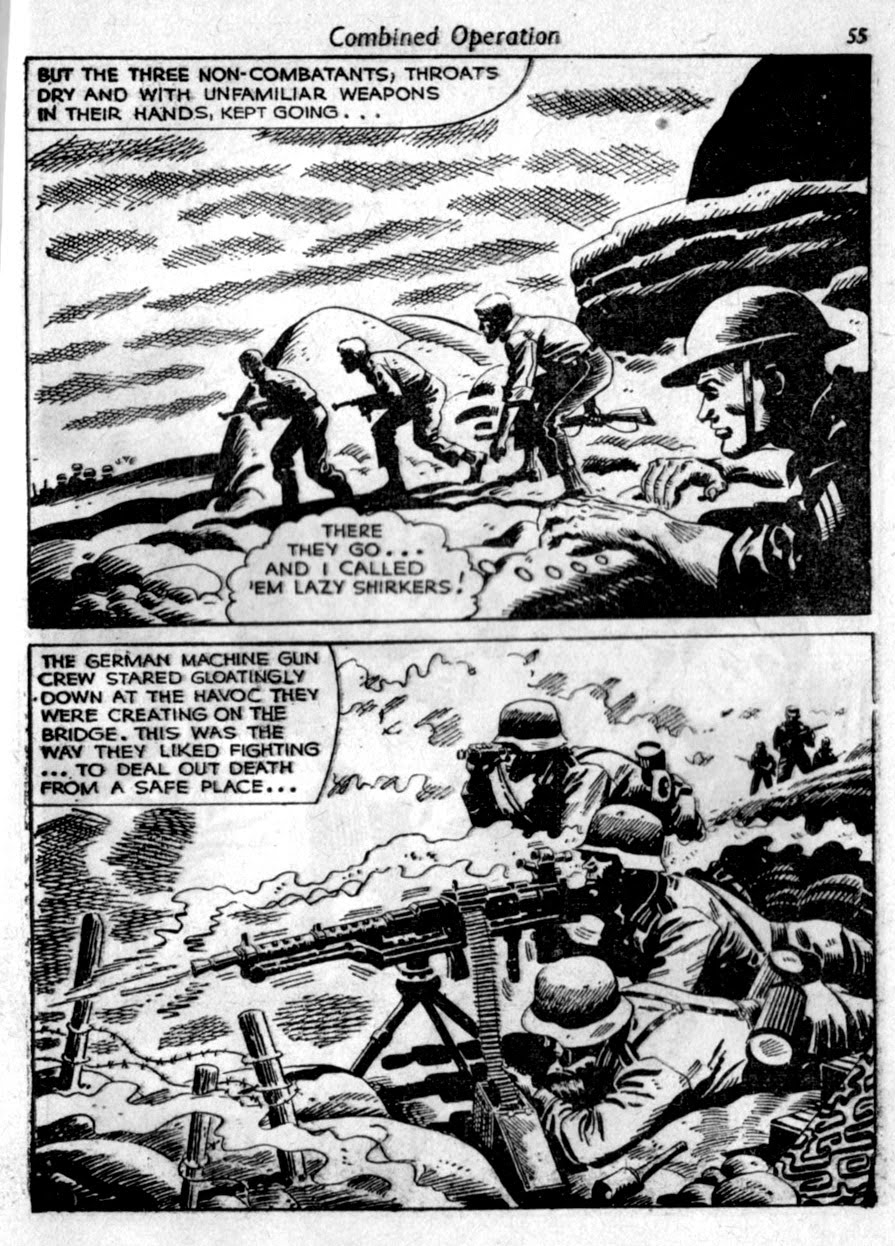
In the meantime here's some examples of Calegari's earliest War Picture Library work from "The Gallant Few" WPL No. 4 and "Combined Operation" WPL No. 14 followed by the opening chapter W.P.L. No. 251 "Red Devils Don't Die", where the increasing maturity and assuredness of his style is plainly evident.

Friday, 26 March 2010

A Journey Beyond The Comfort Zone - The Fantastical Art of Alex Pardee

Alex Pardee is a truly inspirational artist, and I'm not just referring to his work which is an incredible juxtaposition of unsettling and disturbing imagery, presented in a way that is both technically seductive and very thought provoking. But hell no it's more than that - Alex Pardee is a man with a mission statement and the determination to share his art with an uncaring world come what may.

Born in San Francisco in 1976 and weaned on a diet of horror movies and comics (including Tales From The Crypt - of course!) Pardee's work is full of subtle reference points and laden with the kind of in your face imagery that demands your attention. The fact that he's had to battle with truly debilitating bouts of depression is further testimony to his determination to create and build an audience for his work.

There is a burgeoning DIY ethic among young creatives, highlighted by the activities of graffiti artists such as Banksy,  which is really two fingers up to the apathy and self regard of the current art establishment and driven by a resourceful and inventive approach to getting your work out there.

Here's how Alex Pardee went about getting his work out beyond the confines of his bedroom. "I bypassed a publisher and spent my own money and effort hand printing books and secretly shoving them in people's faces by putting stacks of them on the shelves of record stores, bathrooms - anywhere."

Needles to say Pardee's chutzpah and self determination has paid off he's now busy covering a variety of outlets including graffiti, record sleeves, toys (delightfully sick toys - perhaps not suitable for your three year old nephew), skateboards, t-shirts, paintings, movie posters - the list goes on.

His first official art book Awful / Homesick was published in October 2008. Definitely worth adding to your library if you're feeling flush as it's now out of print and therefore tres expensive. He's also collaborated with illustrator Sam Keith on Ojo which was his first major comic, there's a lot more of his stuff out there and to contextualise Pardee's work with many of his contemporaries, the excellent Juxtapoz is a great starting place.

Wednesday, 24 March 2010

Cloud 109 - Episode 22

Well after last week's slight hiatus for the kind of creative musings that do beset many of the creatives whose blogs I visit and who themselves stop by here, we're back on track with another page of the ongoing epic that is "Cloud 109" and as you'll recall Cary who has been incommunicado has just popped up on "facefriendz". Gina and Rabby are anxious to find out what's been keeping him so busy these last few days.

Previous episodes of the story can be found here and here.


Which brings me to the latest development that is occupying much of my attention at the moment and that is mastering the art of Flash animation as David Orme has gently hinted that perhaps a dedicated website might be an idea and truth to tell it's something I've been giving a lot of thought to as well. I think Dave Morris and the amazing Mirabilis team have got it just right, with the way that Mirabilis has it's own blog which is great for networking with other creatives and at the same time you are just one mouse click away from the Mirabilis website where you can read the comic online - lovely stuff.

And talking of blog sites, I must mention one of the first sites that I discovered and found a real inspiration in the early (or earlier) days of Cloud 109, is Garen Ewing's beautiful Rainbow Orchid blog, which is a real event in itself, the whole thing is beautifully designed and a delight to explore. Talking of which Garen has another volume (part 2) of The Rainbow Orchid coming out next month and I would urge all of you to check it out as Garen along with being an incredibly talented artist is also a truly great storyteller and having read the first of The Rainbow Orchid Adventures I am keen to read the next.

And while you're about it check out Tim Perkin's Wizard's Keep site as there is another example of someone with an epic adventure in the form of "World's End" which does at times have me thinking about Richard and Wendy Pini's Elf Quest. Tim's had a lot of experience in the comics industry on both sides of the Atlantic and has some very trenchant comments to make on the comics scene and publishing in general.

So Flash animation is what I'm currently preoccupied with as bats literally start to flap around the Dungeon of Death and leaves start to swirl through the underpasses. I've found over the years that I'm just about totally hopeless at reading tutorials, I can just about manage a couple of paragraphs before severe ADHD kicks in and I have to go back to the start of the sentence, so it really is nigh on impossible for me to follow. But there are some truly easy to absorb online tutorials where you see the whole process unfold before your very eyes in real time. A couple of those and then forget about the tutorials open up the software and just blunder on through. This will work I promise you and it's every bit as quick as doing tutorials by rote. Yes, you will get stuck from time to time as you would doing it via the manual, but the lessons you learn by going down the empirical route will stick with you and you will evolve your own ways of working with the software your wonders to achieve.


We're also in the process of putting together a presentational copy of Cloud 109,  just to see how it's working as a real book as well as having another promotional tool for enhanced networking, it all helps and shows that we've got the self belief to stick with this project, which is I think (I hope) a vital part in the process of trying to make the impossible dream an attainable reality.

Tuesday, 23 March 2010

C'Etait La Guerre Des Tranchees" - War Is Hell Dept - Take 3

Band of Brothers author Stephen Ambrose, used to refer to the Second World War as, "the good war". As the war that shaped my generations perception of such events it certainly appeared to be the embodiment of good triumphing over evil. Similarly the Korean War, however historians might look at it in the longer view, was perceived to be the forces of democracy against the evils of totalitarianism.

So when E.C. editor, writer and artist extraordinaire, Harvey Kurtzman stepped outside the accepted conventions of writing stories set against the backdrop of the then current and unfolding Korean War or recent Second World War and obliged his audience to think about people and soldiers in particular as the victims of war, the ideas he advanced were always in the context of a necessary evil for a better tomorrow.

The First World War did fall within the parameters of Kurtzman's editorial gaze, but aside from Woody's "Old Soldiers", the stories that appeared in "Two Fisted Tales" and "Frontline Combat" and largely delineated by aeronautical maestro George Evans, were stories of daring do set in the skies way above the ravaged landscapes of northern France - they were sanitized and romanticised in comparison to what was going on way down below.

In much the same way the First World War was passed over by the U.K's pocket libraries, who considered it as much too static and too grim to deal with outside of the exploits of flying ace Dogfight Dixon, until in 1979 writer Pat Mills and artist Joe Colquohon created the story of the semi-literate Charley Bourne and cast him into the trenches of war torn Flanders and created "Charley's War" a comics masterpiece.

But the truth was that the First World War was by and large just too grim and depressing for anyone to really want to tackle. It wasn't a good war, it was the might, greed and self interest of wealthy industrialists and bankers (sound familiar?), spurred on by corrupt politicians (sound familiar?) and facilitated by a military elite barely able to comprehend the consequences of the new warfare they were about to lead their armies into, with the fading hegemony of once great empires as the catalyst to the ensuing horror.

Not a good war by any means.

It is this war that has fascinated and obsessed Jacques Tardi for much of his life. Born shortly after the Second World War and raised as a French citizen in a part of Germany ceded to France after the end of that conflict, he was fascinated and horrified by the stories that his grandfather told him about life in the trenches. Tardi's work which is distinguished by an unstinting attention to locale and detail, captures the true horror of war in a way that no other artist has been quite able to achieve. As with the story that you are about to read there is a look of utter hopelessness in the eyes of the protagonists, this isn't about war with either Frenchman or German as the victor or the vanquished, it's the story of the little man, the man that keeps his nose to the grindstone, the man that does what his betters tell him to do, the man that plays the game according to the rules formulated by the system, the establishment, the men in suits. This is the story of man against the system, with the system as the ultimate winner.

This is a story for our times ...

The whole of Jacques Tardi's epic It Was the War of the Trencheswill be published by Fantagraphics Books on April 20th.


Saturday, 20 March 2010

"By George!" - It's Dave Morris's Birthday!!!

Sorry but I couldn't resist, Dave Morris co-creator of the utterly beguiling Mirabilis (story here) has a birthday today - so many happy returns Dave from both David and myself and as promised I have ventured down into the vaults and returned with a real gem of a story that I hope you'll love as it has elements that make me think of Mirabilis with it's richly spun fantasy neatly counterpoised with a real sense of history and a hint of classical antiquity.

"By George" was one of the then 21 year old Al Williamson's earliest efforts for E.C. and unlike many of the other stories that he would work on this was pretty much a solo effort with a little bit of assistance from Jack Hearn (not, contrary to popular myth, George Evans) inking some of the faces on the intro and outro to the story, (Williamson at the time was very hung up on his ability to ink faces convincingly). The resultant story is a tour de force. The script by Gaines and Feldstein, which would have been one of several produced in a morning's brain storming session, with Feldstein then drawing up the panel borders and adding balloons and captions before assigning the boards to Williamson, is one of the team's all time best and Williamson's artwork which is a passing homage to Hal. Foster's "Prince Valiant" as well as a continuation of his ongoing love affair with all things Flash Gordon, is simply stunning and best viewed in black and white where you can fully appreciate the near painterly qualities he was able to add to the story by his masterful use of craft tint.

The work which Williamson produced for E.C. during those halcyon days was at times achingly beautiful and the product of a lot of soul searching and agonizing as he would dash of a succession of panels at a speed almost veering towards commercial viability before becoming totally hung up on one panel which would then take him literally days to resolve.

I've also included E.C. colorist Marie Severin's guide to Feldstein's cover artwork to the story, which as well as having the usual Feldstein punch, is an interesting counterpoint to Williamson's treatment.

Happy Birthday Dave!