Monday, 21 December 2009

3-D-Mentia!!!

In 1954 as events were conspiring against William Gaines', he was still determined to be at the forefront of new developments in comic reading. As a result and hot on the heels of the 3-D craze sweeping U.S. movie audiences, comic publishers were experimenting with applying the same technology to the printed page. The first 3-D comic with the imaginative title "Three Dimensional Comics" had sold over a million copies the previous year and it's inventor Leonard Maurer in partnership with his brother Norman and Cartoonist Joe Kubert (yes - THE Joe Kubert) had hopes of licensing the technology to other comic publishers.

That was until the ever resourceful Gaines who was already the owner of a StereoRealist camera, made a search of patents and discovered the whereabouts of the original inventor of stereoscopic cartoons for newspaper repro, who had taken out a patent for precisely this procedure in 1936. Gaines swiftly made contact with the now frail and elderly Freeman H. Owens and bought the patent off him for the princely sum of $100.00. He then initiated a patent infringement suit against all his rivals and whilst the case was ultimately dismissed as being vexatious in the extreme the damage was done as regards the ambitions of Maurer and his partners and 3-D comics were destined to become yet another in a parade of developments which in retrospect seem more like gimmicks than real pushing of the boundaries.

However Gaines' footwork did enable him to exploit the medium with his own band of highly talented creatives and 2 E.C. 3-D comics were published. The first titled simply 3-D EC Classics was a collection of four stories from across the range of EC's output. The second collection Three Dimensional Tales From The Crypt of Terror reprised a selection of stories from EC's horror output.

A third collection devoted to the best of EC's science fiction comics was prepared but never saw print. Eventually the four stories were reprinted in the EC fanzine Squa Tront and Wally Wood's Witzend, where Wood's masterful treatment of "Spawn of Venus" finally made it's first appearance.

A note on the production process undertaken by the artists concerned is worth running past you.
The first image you can see is a page of original artwork from Wood's "V-Vampires" which was arguably the most successful of the stories to see print. As you might be able to discern what you are in effect looking at is a series of cels with artwork on each cel representing a layer with the final layer being the base board background artwork on which all the other cels are affixed.

The procedure for the artists involved was painful in the extreme.

Firstly the artist would pencil the page on an ordinary sheet of art paper with holes punched into the top margin which he would affix to an animator's peg board. When the penciling was complete he would note down next to every item drawn what layer it would ultimately appear on. You'll notice the numbers on Woody's penciled page second image down.

Then he would start tracing onto celluloid using the peg bar to affix the pre-punched cel sheet so that everything remained in register. All figures and objects on that particular layer are thus traced onto the cel.

When each layer of cel inking is complete he repeats the process apart from the last and deepest (stereoscopically speaking) which is inked up on the original sheet of art paper.

But that's not the end of the process for the artist, as each item must be rendered opaque while it's surrounding cel remains transparent. To achieve this the artist then needs to flip over each cel and paint on the reverse side of each drawn element with white paint again much in the manner of the trace and paint department of animation studios for much of the past century.

Tedious in the extreme - what!? And of course for each level (most publishers would settle for three or four but EC went for five to six), it was necessary to include loads of extra detail that wouldn't normally be required in a regular comic, the kind of detail that disappears behind objects but in 3-D comics needs to be drawn.

The final artwork was then sent off to repro where it would be shot as it was delivered and then at the next stage each layer would be shunted a bit to the right, the further away the background elements the deeper the shunt.

Then one photo is printed in red and the next is printed in green and the resultant page is viewed through those wacky looking red-green 3-D glasses and an illusion of 3-D is experienced by the viewer.


An absolute nightmare to draw but the results of the best comics and in particular Wood's "V-Vampires" is truly impressive. Anyway here's "Spawn of Venus", see if you can spot the panel where the charming street scene from the third image down appears.

Saturday, 19 December 2009

Gesture Drawing (Revisited)

Essentially there are two ways of drawing a figure from imagination, the first and in some ways most sensible way is to conceive of the figure as a collection of blocks and cylinders and keeping true to the pre-designated proportions of the average human or the somewhat idealized proportions of the kind of people who regularly sashay around Manga and Superhero comics you then proceed in an orderly direction to construct your drawing. The example here is courtesy of George Bridgman's Life Drawing a book that was recommended to me by none other than Ian Gibson, who was less than impressed with my parlous figure drawing. It is I think a little less parlous these days and any success that I have achieved in this direction I attribute to Messrs Gibson and Bridgman.

Anyway lets assume that you have at least got a rudimentary feel for anatomy and that you have immersed yourself in some good life drawing books and classes aren't a bad idea either, plus most of us see people on a daily basis in one form or another so carry a sketch book and draw them whenever possible. You're building up knowledge and avoiding the trap of settling into faulty pre-conceptions of figure work.

So you've got all this knowledge tucked under your belt, now you start to work up your figures from imagination, with method one which I'll call the considered approach you continue following the constructivist building up of the figure as a series of blocks and cylinders following what you've absorbed from Bridgman. This has the advantage of putting you in the position of having to analyze exactly what it is that the figure is doing before you put pencil to paper - it really forces you to think.

But this is also the disadvantage of this approach - it is considered and it doesn't allow for you prodding your subconscious.

Method two, which is often referred to as gesture drawing is the polar opposite to the constructivism of method one. With gesture drawing you absorb the lessons of Bridgeman and then you throw the book away and scribble what you feel the figure might be doing. This is much, much more intuitive but it's also more exciting. It's not unlike being confined to bed with nothing to stare at but a damp patch on some textured wallpaper - after a while you can start to see the most amazing scenes revealing themselves and this is essentially what you're doing with gesture drawing. You are creating the opportunity to stimulate zones of your subconscious and pull forth memories and impressions which drawing in the pre-ordained manner of the constructivist approach doesn't cater for.

Pre-eminent amongst the school of gesture artists is Frank Frazetta, here's some of his drawings which shows his sense of rhythm and fluidity that suffuses all of his work and a couple of pages from his last comic book story from Creepy No 1. After this story appeared Frazetta devoted himself entirely to his painting producing a simply phenomenal run of covers for Warren, but with this story in contrast to the stories of all the other artists appearing in that issue Frazetta's piece stands out as being uncompromisingly visceral and edgy, everything is crackling with life and dynamism, even if individually some aspects of the drawing aren't as fully resolved as the Reed Crandall or Al Williamson pieces appearing in that same magazine. You can see the influence it had on a young Berni Wrightson in the following Web of Horror story, which first appeared in issue one of that magazine when Wrightson was still only twenty but clearly absorbing the lessons of the master.

Interesting how this story neatly anticipates the compulsive and addictive tendencies of on-line gamers, which in 1969 would have seemed an incomprehensible concept to most Web of Horror readers.

Friday, 18 December 2009

Web of Horror

As mentioned in a couple of earlier postings there was a period when the Warren line of magazines, well at least Creepy and Eerie looked distinctly dire. The problem was created by Warren's move from Philadelphia to New York combined with a downturn in sales of his magazines. As a result budgets were slashed and a lot of his creatives were obliged to either work for a fraction of their previous page rates or seek employment elsewhere. Hence the rapid loss of quality as reprints and so-so artwork and scripts filled out the pages of Creepy and Eerie.

Terry Bisson who had already started to submit scripts to Warren with his friend Clark Diamond was hired by Long Island based publisher Robert Sproul to create a rival horror mag. Sproul already had a line of imitations going with Cracked (Mad) as an obvious example. Bisson's remit was simple with the aid of Diamond he just needed to hire enough people to fill out the pages of the new and as yet untitled magazine.

Jeff Jones, Mike Kaluta, Berni Wrightson, Bruce Jones all hung out together and shared a passion for gothic fantasy and E.C. comics, once Bisson had secured the services of one, he'd got the rest and it was around these talents and Ralph Reese and Wayne Howard both working as studio assistants to Wallace Wood and able to recreate the classic Woody E.C. style that Bisson launched his magazine, ultimately titled Web of Horror.

The debut issue with cover by Jeff Jones and artwork by many unfamiliar but nevertheless intriguing if not downright exciting talents so alarmed James Warren that he sent all his creatives a them or us ultimatum; i.e. you could either work for Warren or the imitators but not both.

Three issues were produced and a fourth issue was put together under the editorship of Berni Wrightson and Bruce Jones. Bisson and Diamond who were doubtless cognizant of the change of fortunes with WOH's funding, had relinquished the editorial reins and skipped town to join a hippy commune somewhere in the deep southwest. The fourth issue as we know never appeared but most of the stories that had disappeared along with most everything else from Sproul's Long Island offices were eventually retrieved by Frank Brunner, one of Web of Horror's latter contributors.

Here as a taster is a particularly fine Wrightson tale from the third and final issue - with many thanks to Mr Door Tree and his excellent Golden Age Comic Book Stories blog for these scans. I do have these magazines somewhere but time as ever is not on my side.

Wednesday, 16 December 2009

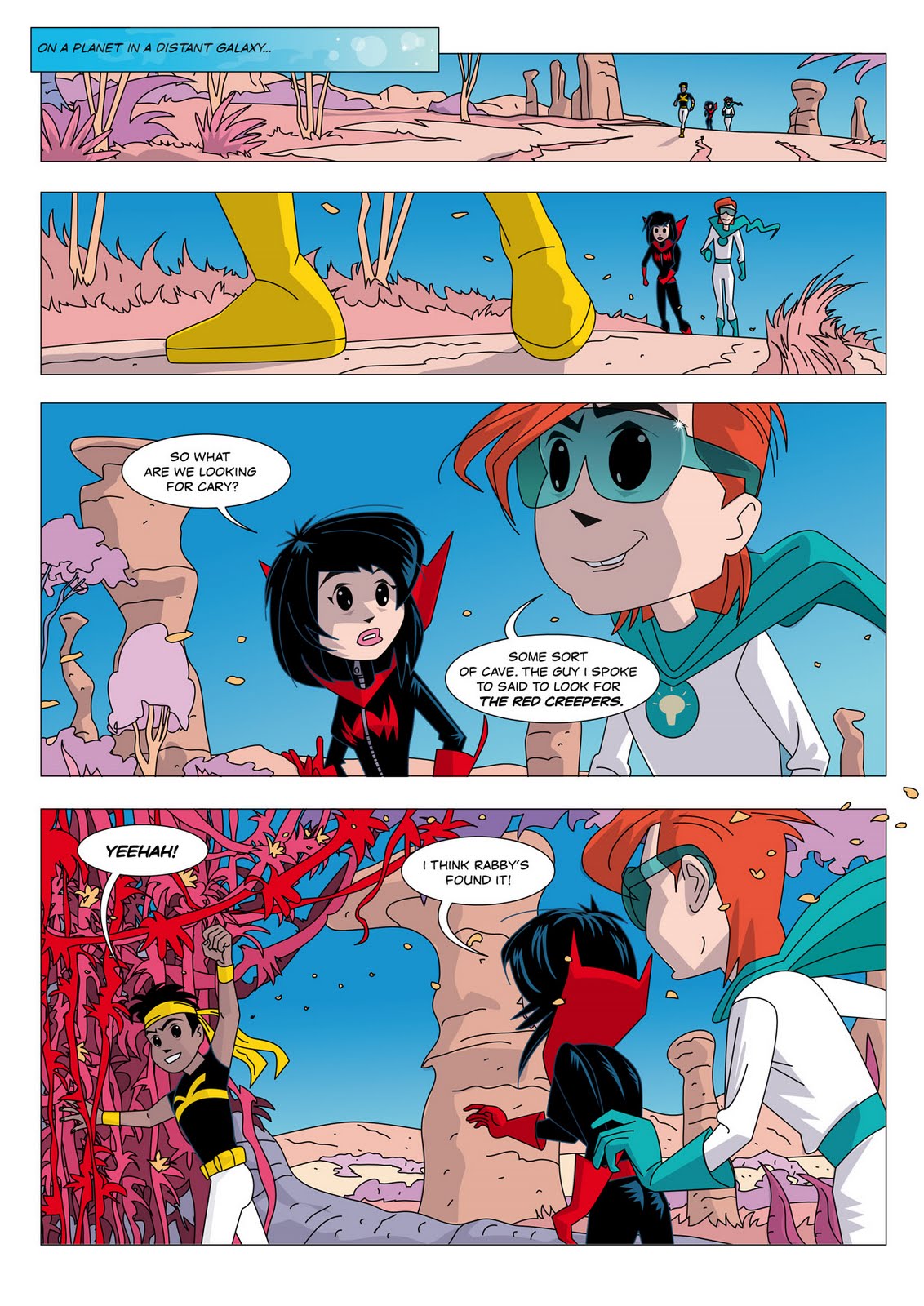
Cloud 109 - The Eleventh Instalment

Well we're at the start of the next game in the cyber world of Cloud 109 which Gina, Cary and Rabby have to undertake if they want to gain any more of those all important credits and as an aide memoire I'll reprise the previous pages to aid with the flow.

Because today is our weekly Cloud 109 update day I'm taking a break from the postings of Christmas Creep Comix and instead I'm going to run several items that have caught my eye recently which you might be interested in checking out. Firstly and very much in the vein of those wonderful Warren magazines of yore, Dave Morris has a really engaging spook out comic of his own over at The Mirabilis Blog. Scintillating script is by Dave and the beautifully atmospheric artwork is by Martin McKenna, who is an exquisite draughtsman (check out his version of Estelle from Mirabilis) whose work would have blended seamlessly into the pages of Creepy magazine when it was in it's golden age.


In addition I'd also like to mention an online phenomenon going under the name of Fractal Fiction, it's an ongoing comic involving several creatives who are posting pages on a regular basis. Total weirdness but strangely compelling with some delightful nuances and well worth a visit.


Tomorrow it's going to be back to creeping you out with the much anticipated Berni Wrightson shocker Jenifer a masterpiece in marker pen, created on a lightbox but more of that tomorrow, for today I hand you over to Gina, Cary and Rabby as they venture into the portals of "The Dungeon of Death".

They're going to be there for quite some time ...

Tuesday, 15 December 2009

Serendipity


There is definitely a serendipitous nature to blogging - well at least in terms of this blog. My decision to reprise some of my favourite horror comics in the run up to Christmas, has been so well received by you guys that it's got me digging up as much additional material as possible to shed some more light on the genesis of the Warren line of comics.

Yesterday's posting, which made brief mention of James Warren's early experiments with fumetti like use of photos in some of his monster magazines did remind me that one of the key players in those early years had posted a fascinating reminiscence about his days with Warren. Russ Jones was the first albeit short term, editor of Creepy and how that comic came together is described in some detail by Russ here.

As you can surmise the term serendipitous can also be applied to the way in which Russ came to work for James Warren and certainly does apply to the way that first landmark issue of Creepy came about. There's a lot more on the evolution and history of the entire family of Warren magazines in David Roach and Jon B. Cooke's excellent and essential, "The Warren Companion". If you can't get hold of a reasonably priced copy (it's retailing at Amazon for £95.00) it's available as a Google Book on line - immediately - now!

The story I'm going to run past you today which appeared in issue 75 of Creepy, was when it appeared jarringly atypical. If Creepy and Eerie were a reprise of E.C.'s Tales From The Crypt, Vault of Horror and Haunt of Fear, then the story in question "Thrill Kill" would have seemed to stem from the much more polemical and controversial fare that had so characterized Shock Suspenstories. Jim Senstrum the story's author had attempted to break into comics at the age of 19 by sending Stan Lee a twenty page Hulk story that he had put together in his basement whilst as he put it, "all my friends were out on dates and driving around in hot cars". Lee was evidently impressed enough to invite the young Senstrum to New York the following week but as luck would have it, came the day and Lee was unavailable and it was John Verpooten who met Senstrum. The meeting came to more of a pat on the back and keep up the good work.

A break for army service followed and then it was back to pitching comic ideas with a vengeance, unable to secure the assistance of a reliable writer, Senstrum started creating his own scripts and it was John Cochran then working for Warren who bought the first of what was to be many scripts from Senstrum. Senstrum's agenda was still to make it as a full time comic penciller but along the way he discovered he had a real talent for writing - serendipity kicks in again!

The title "Thrill Kill" was also to an extent the product of serendipity having first entered Senstrum's consciousness several years earlier as a great title devoid of any plot when he encountered a private Thrillkill while still on basic training with The National Guard in Minnesota. The resultant story with it's real life "Texas Tower" references and documentary style exposition was unlike anything that appeared in comics before. Editor Bill DuBay considered the script so exceptional that he scrawled "For Neal Adams Only" across the draft.

Here then is that story as it appeared nearly thirty five years ago and still just as powerful and all too resonant.

Monday, 14 December 2009

Dracula, Fumetti and James Warren

I'm going to tease you with another recent production from the ongoing epic that is Cloud 109. The page in question is when Gina, Cary and Rabby manage eventually to re-boot themselves out of the increasingly hellish Dungeon of Death game and return to the cyber-lounge, but as you can see David's script required a horror version of the lounge.

This enabled me to have great fun with lots of goth symbolism and draw in a few references to films of yore. Sadly Tom and Sheryl are no longer an item, they've both gone and got themselves new partners - hence the bleeding heart with OTT dagger, but Sheryl is (I believe) still cool with appearing as the female lead in this epic and the thought of having to remodel Gina every time Tom ends up with a new G/F is too painful to contemplate. Sheryl is absolutely perfect for the role, so if you're reading this Sheryl you are still forever ensnared in the cyber world of Cloud 109. Bottom line is there is no escape until the books are completed.

Now the observant amongst you will doubtless notice one or two luminaries from the annals of horror but there is a delightful little detail regarding Rabby's jacket which I lifted from the jacket that John Van Eyssen wears in his portrayal of the luckless Jonathan Harker in the Hammer production of "Dracula" ("Horror of Dracula" in the U.S.) which was released in 1958. To my mind it still ranks as the best of the entire output of Hammer films. The adaption of Bram Stokers text does take terrific liberties but the result is a film full of pace and dynamism and Peter Cushing and Christopher Lee are perfect in their roles of Dr. Van Helsing and Dracula.

Martin Scorsese, Quentin Tarantino, George Lucas all cite this as being a key influence on their cinematic sensibilities and you could add to this list a host of other creatives including one James Warren, publisher extraordinaire. Prior to the debut of Creepy, Eerie, Blazing Combat and Vampirella, there was a line of comic adaptations of horror films that Warren was putting out as individual titles in their own right as well as running some of them in his horror magazines, Famous Monsters of Filmland and Monster World. The comics were painstakingly assembled from a mix of production stills and blurry screen captures, in fact the process was such a nightmare that latterly the stories were redrawn by Russ Jones (Creepy's first editor) and Wally Wood with Joe Orlando pitching in. The experiment was a brief run and immediately preceded the debut of Creepy magazine but there were some interesting anomalies thrown up by the adaptation of Dracula for the one off Curse of Frankenstein/ Horror of Dracula magazine.

Hammer films were apparently released in three different versions due to censorship requirements. The longest versions were released in Japan and had the least censorial excisions, next came the U.S. version and last and most heavily excised came the U.K. version. The scene of Dracula's facial decomposition was removed from the U.K. and U.S. releases but did appear in Japan and also in Warren's adaptation.

But well worth a check out, there is a beautifully pristine print which was used for the U.S. DVD release which does include the re-instatement of the Lucy Harker stakeing.