Monday, 23 January 2012

A Thousand and One Nights - Kay Nielson's Postumous Postscript

In 1976, a minor publishing event occurred when Pan books visionary editor David Larkin released a paperback edition of Kay Nielson's Illustrations for One Thousand and One Nights. For lovers and connoisseurs of the Golden Age of Picture Book Illustration it was a major event. For although some sixty years earlier, Nielson's exquisite illustrations for East of the Sun and West of the Moon had secured him a lasting claim to fame as one of the prime exponents of early twentieth century romantic illustration, his fame was as fleeting as other illustrators of this genre, such as Edmund Dulac.

By the 1930's times were a' changing and with it the sort of work that an artist of Nielson's undoubted genius, but limited repertoire could command. He eventually accepted an offer from the Disney studio (readers of this blog will recall that Walt's European tour which preceded work on Snow White had seen him snaffle up lots of beautifully illustrated books with a specific intent to infuse his story, background and styling departments with artists that were automatically on message with the visions that Disney had surging through his head).

So Nielson with his wife Ulla following on, left his native Denmark and pledged his troth with the Mouse Factory. He proceeded to work his darndest creating some truly inspirational concept drawings for what would turn into The Night on Bare Mountain and Ave Maria sequences of Fantasia. He continued at the studio with a pile of conceptual work for an adaptation of his fellow Dane, Hans Christian Andersen's Little Mermaid. The project was to be eventually shelved until 1989, when work was commenced in earnest on the film that would signify the moment when the Disney studio having reached a point of near collapse following their disastrous attempt to make a feature length film from Lloyd Alexander's The Black Cauldron, re-emerged as the force it once had been in film making.

However, I digress, Kay Nielson's tenure at the studio was relatively brief and his remaining years were eked out seeking work which was becoming progressively more elusive. But such was the charm and warmth that he and Ulla exuded and such was the generosity of their near neighbors that somehow or other they struggled through in elegant penury until Kay passed away in 1957 at the age of 71 to be followed by his wife a year later.

Before she passed on Ulla gave their friends and neighbors Hildegard and Frederick Monhoff a box of paintings for a book that was never to be published. Despite approaching museums both in the USA and Denmark the Monhoff's could find no one remotely interested in sharing these artworks with the world.

No one that is until the Monhoff's approached Elizabeth and Betty Ballantine who issued the illustrations in an identical format to their highly successful Frank Frazetta collections and as David Larkin had co-editioned the Frazetta books under the Pan imprint it seemed logical for him to co-host the Nielson paintings.

So here they are:

Tuesday, 10 January 2012

Boot Camp for Artists

The number of simply superb Spanish and Italian illustrators and painters, who refined their craft in the UK comics of the 1950s-70s is simply astonishing. In fact the phenomenon was part of the rationale behind a fanzine that I used to print off on a desk top printer some twelve years ago. Achtung Commando! was founded on the principle that there were a lot of people who were into Commando comics who just didn't seem to know that many of the artists they were oohing and ahhing over had worked far and beyond the confines of the pages of the world's longest running pocket library. Similarly, there were devotees of Warren comics that were blissfully unaware that many of the artists whose work they were so captivated by had actually learned their trade working for publications such as Commando and it's Fleetway rivals War, Air Ace and Battle Picture Library.

The little A5 fanzine was printed in full color and hand bound and trimmed with glossy covers, the whole operation crunching through buckets of Epson ink cartridges. Unbelievably, even with the deterrent cover price of £15.00 the little fellas sold well, in fact sales for each issue were well into three figures and there was always demand for back issues. There was a niche market who seemed to enjoy finding out more about Commando and more specifically the people behind the comics. All in all it was a fun project and I got to network with a lot of fellow enthusiasts as well as having the fun of interviewing many of the artists and writers.

I am very much reminded of those days as I work on the last elements of the first volume in Book Palace Books new publishing venture Illustrators, which includes a fascinating interview with Ian Kennedy, who is to many enthusiasts forever associated with Commando, but as the interview and accompanying artwork attest, there is a lot more to be explored. As I cast my mind back to creating that first issue of Achtung Commando!, I remember chatting to the ultimate resource for UK comic historians, Mr David Roach. David as I have mentioned earlier is the man that appears in the credits for many comic and illustration retrospectives, as he is such a passionate researcher of all this material.

David it was who identified one of my all time favorite Commando artists (although he only did perhaps two or three issues). Juan Gonzalez Alacreu (not to be confused with Pepe Gonzales of Vampirella fame), was a consummate draftsman and a man obsessed with light and form. Like many of his contemporaries working in Barcleona's busy studios, he would utilize photos for many of his facial references, but his mastery of form and design enabled him to use such props creatively rather than being restricted by such aids. His fascination with light and capturing it's effect on form, made his work stand out from his contemporaries. He would literally take a scalpel blade to the surface of his work to add reflected light and texture to add further dynamism to his drawings.

Here's some examples from a couple of Commando comics; Dangerous Dawn and Terror Team (both worthy of inclusion on Commando's current list of titles worthy of reprint) from the late 1960's and here are some much more recent examples of his paintings which show the same preoccupations in an albeit much more serene setting.


And while we're about it, here's the latest four issues straight from operational HQ in Bonnie Dundee:

Commando 4459

Invasion Watch

In the early days of the Second World War, men too young, too old or too infirm for the regular services flocked to join Britain’s Home Guard to “do their bit.” Because of this, the units were dismissed as a bit of a joke in some quarters.
   If those nay-sayers had listened to the conversation in one Home Guard headquarters on a night in 1940, though, they might have changed their minds. For as the men there shared their stories it became very clear that they had fought, and would fight again. And fight like the demons they were.
   Invaders beware!


Script: Mac MacDonald
Art: Carlos Pino
Cover: Carlos Pino


Commando 4460

Warriors!

Fighting men come in all shapes and sizes. They wear different uniforms and follow different flags. But the best of them share one quality. And that one quality marks them out from everyone else as men to be feared and respected in equal measure.
   That’s the quality that marks them out as…

Warriors!


Script: Mac MacDonald
Art: Keith Page
Cover: Keith Page


Commando 4461

Upside Down Ace

Alan Burnett and Colin Harvey flew as the crew of a Boulton Paul Defiant night fighter. They shared the same room and spent almost every second of every day with each other…yet the very air around them seemed to vibrate with the fierce hate they had for each other.  

   But, despite their bickering and brawling, they had the highest score of kills in the Group. How they kept it up was their own special secret… 

Introduction by Calum Laird, Commando Editor

The Boulton Paul Defiant was one of many planes which didn’t quite live up to their designers’ hopes. But you’d never guess that from Ian Kennedy’s dynamic cover where, as only he can, he turns the world on its head to create another perfect composition.
   Inside, John Ridgway — in only his second Commando outing —delivers an ideal complement to the cover, his crisp, accurate linework being perfect for aircraft illustration. Being a trained draughtsman is quite an asset.
   The script, by Brunt, gives them him full rein to tell the Defiant’s story while at the same time touching on some of the super-secret “boffins’ war” that went on behind the action in the Second World War.

Upside Down Ace, originally Commando No 572 (August 1971), re-issued as No 1604 (May 1982)

Script: Brunt
Art: John Ridgway
Cover: Ian Kennedy


Commando No 4462

Death Of A Wimpey

They found an abandoned plane in the desert, sand almost covering it. The paint was hanging off in shreds, the engines had seen better days and the fuselage was riddled with bullet holes. But it was still a Vickers Wellington bomber…one of the tough, famous Wimpeys. And it could fly — just.
   So the men who found it, three army deserters and a no-good R.A.F. pilot, began to make plans to get back into the war — flying their own private bomber!

Introduction by Calum Laird, Commando Editor

At the end of October last year at the Dundee Comics Day, two men were honoured for their outstanding contribution to the comics artform. Though they are not related, they share the same surname and, as you can see from this book, they have both worked for Commando.
   I’m talking, of course, about the two Kennedys, Cam and Ian who together have produced the art for this tale. Ian’s cover wonderfully captures a stricken Wellington bomber trying desperately to land, while the characterisation and movement Cam brings to the inside art is outstanding.
…And let’s not forget scriptwriter Ken Gentry without whose contribution this classic Commando story the two Kennedys would never have had the chance to showcase their talents so well.
   By the way, I got to present the awards — how cool is that?

Death of A Wimpey, originally Commando No 469 (April 1970), re-issued as No 1335 (July 1979)

Script: Ken Gentry
Art: Cam Kennedy
Cover: Ian Kennedy

Commando © DC Thomson 2012

Saturday, 31 December 2011

A Spooky End To A Spooky Year

I have just read of the discovery of what for many fans of films that go bump in the night is something of a holy grail. The preamble to my uncovering this bit of news is that I had determined that whatever else happened today I had to make another blog posting before the year end. To this effect, I decided to do one of my brief updates on my current illustration activities and as this involves a series of books devoted to a team of daring girls who dedicate themselves to unsettling the best laid plans of vampires, ghouls and zombies I was trawling the internet for some examples of the vast hinterland of trash culture that informs these images.


In particular there is one image which is very closely allied to a sequence from Hammer Films Dracula (Horror of Dracula as it was in the US). The sequence in question is toward the climax of the film and is heavily laden with sexual innuendo as Dracula slowly and lasciviously reveals the fangs that are about to render the lovely Mina Holmwood as yet another slave to his malevolent bidding. As he does so there is a subtle tinkling not unlike the shiver of a dozen shards of glass which adds an extra frisson of anticipation to the occasion.

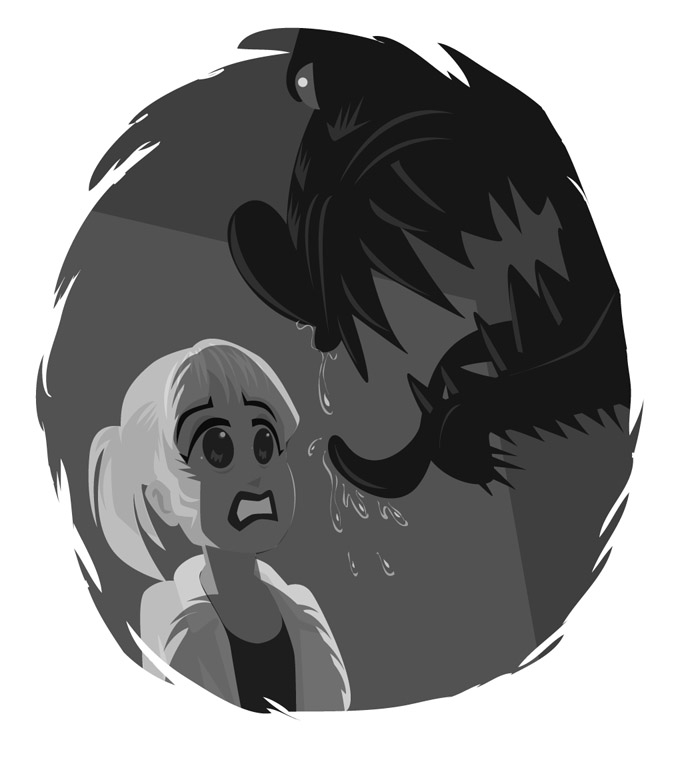
This is what I had in mind when I created this image illustrating a moment when one of the aptly named Spook Squad girls is menaced by a vampire.


But as I checked out various links I discovered that the cartoonist and writer Simon Rowson, aided by his Japanese wife Michiko, had managed to finally track down the least censored print extant of what was Hammer's finest Dracula film. It has long been common knowledge amongst Hammer devotees, that the studio would issue three different cuts of it's films. The UK would have the most heavily edited to conform to the very strict censorship rules that applied, the US would have the next longest and the Japanese whose censors seemed quite liberal in comparison would have the longest versions. It was this image from Warren's comic strip adaptation that gave a clue to what the Japanese might have seen which the rest of the world hadn't that gave added impetus to the hunt for the missing print.


It was down to the superb teamwork and dedication to the project of Simon and Mitchiko who are based in Tokyo, that enabled them to finally locate a partial print of the Japanese cut of the film. The first five reels of the film had been lost in a studio fire in 1984 but reels 6, 7, 8 and 9 still survived and as the most heavily censored scenes, including the climatic disintegration scene occurred towards the end of the film this was indeed a fortuitous outcome. Simon was able to view  the last two reels and as well as the disintegration scene including the much speculated close ups of Christopher Lee's face, there were other snippets from the Mina Holmwood seduction scene which were absent from the versions familiar with audiences in the West.

The lost footage is apparently going to be included in a forthcoming UK release of this fabulous film.

Can't wait!

Wednesday, 21 December 2011

Message For Lovers of Contemporary Art (especially Simon!)

 Do you remember Jiminy Cricket? Old Jiminy was the little grasshopper character that was appointed Pinocchio's conscience by the Blue Fairy. And every time old Pinoke was going astray, little Jiminy would be whispering in his ear and trying to steer him back onto the road of true righteousness.

Well, I have my own Jiminy Cricket although he is slightly larger than the dear wickle Jiminy, but like Jiminy his word is to be heeded. Simon is a dear friend and occasional cricket... err critic of this blog. Simon has divined that most bloggers have their comfort zones and mine are he reminds me, becoming all too apparent.


I did make an effort yesterday by referencing the work of the little known but singularly gifted Bill Mevin, but as Simon rightly observed I did grab hold of the old comfort blanket by mentioning Ron Embleton, who I have to admit, is something of a recurrent theme in many of my posts.

Counsel for the defense submitted that their client also made mention of J. Arthur Rank, David Hand and British Gaumont (aka Rank Organization), who have never featured in this blog before, but the verdict was pretty damning, and I am for the moment hanging my head in shame.

If fate was kinder I would love to devote one blog posting to Simon's incredible photography. This man who lives in the deepest and darkest part of rural Sussex is without doubt one of the world's greatest glamor photographers and somewhat insanely he has never had an exhibition of his work, I am one of the relatively few people on the planet to have seen these works along with the beautiful women who are so entranced by his work that they offer themselves up as eager subjects for his lens.

But for the moment these amazing works will just have to remain the stuff of legend, whilst I run past you chaps and chappesses the latest issue of Be Street, which has so far managed to avoid mention of Frank Hampson, Ron Embleton, Denis McLoughlin, Ian Kennedy, Carl Barks, Floyd Gottfredson, Al Williamson, Steve Ditko or even Bill Mevin.

But it is super cool with fabulous layouts, some great artists and a short feature on illustration legend Mick Brownfield (a feature on Mick will also be appearing in an upcoming issue of Illustrators), who sent me the details which I am now sharing with you.

Be Street's Facebook Page is here

Be Street'sTumblr is here

And Be Street's Twitter is here

Tuesday, 20 December 2011

Merry Christmas From Wee Sporty, Bill Boffin and Yours Truly


As readers of the recently published Wulf the Briton magnum opus will recall, there was one week in 1959, when Wulf the Briton did not make Express Weekly's front page. This enviable slot had been his regular and unchallenged fiefdom ever since Ron Embleton's masterful development of the strip had threatened to usurp even the pre-eminence of Dan Dare. The week in question was for the issue cover dated December 26th 1959 and by this stage of the game Wulf was on a real roll, with seething rivalries between a breakaway faction of the Brigantes under the leadership of the beautiful and scheming Cartamandua and the remainder of the tribe under the leadership of their king Venutius, cuckolded husband of Cartamandua (although this was never spelled out for obvious reasons) leading to some of the most spectacular battle sequences ever seen in any comic, anytime, anywhere. And if that wasn't enough earlier in the year there had been gladiatorial combat, siege and starvation in the depths of a cruel winter with a vengeful Marius Actus and the 20th legion determined to destroy Wulf and his followers and in the run up to Christmas there had been yet more landings as the forces of Imperial Rome under the command of Agricola set about to bring order to the unruly Brits. But while all that was going on Wulf and his comrades in arms Basta and Greatorix, had their hands full with a bunch of Saxon Vikings who were wreaking havoc on the Northern coasts.

So when my Christmas issue of Express Weekly arrived I was momentarily mystified, but only for a moment as I saw Wulf make his only ever appearance as a truly spectacular, full color double page spread across the center of the comic. The front page was in the meantime reserved for Bill Mevin's Wee Sporty. Mevin it should be mentioned was a highly talented illustrator, whose training had included a stint working under the directorship of David Hand, who (according to who you read) was at one time Walt Disney's creative right hand man. Hand left the studio in 1944 somewhat disillusioned in the wake of the strike that had nearly crippled the studio in 1941 and the resultant unionization. (Hand pictured above second from left in the storyboard discussion photograph) Disney never really forgave Hand for leaving and was firmly of the opinion, despite Hand's denials, that his move was as a result of an approach from the UK's Rank Studio. J. Arthur Rank was a man whose ambitions seemed limitless as regards creating an Albionesque version of Hollywood, complete with stars (under contract to Rank) and epic productions, directed by some of the most exciting home grown talents that would see the studio as a credible force in international cinema.


The inevitable happened and after work on the full length feature Animal Farm was completed and the studio had failed to secure a distribution deal for it's animated cartoons series Animaland and The Musical Paintbox, the J. Arthur beancounters pulled the rug out from under Hand and his studio and for Mevin and a lot of the other talents, they had to ply their skills elsewhere.

For Mevin, the break was something of a blessing in disguise as he was able to develop his own ideas and style rather than expending energy on work which was so heavily Disney influenced (doubtless at J Arthur's behest), that it looked way too dated before it had even been shown to audiences that would inevitably make less than favorable comparisons with the epics being produced in the Mouse Factory.

Mevin's style blossomed and moved with the times and included a lot of TV based cartoon strips for such series as Dr Who, Bugs Bunny, Space Patrol and newspaper work such as the Mevin creation The Soapremes and The Perishers.

I'm also including a couple more Christmas themed pages from the same issue to help with such things as part games. Courtesy of the inimitable Bill Boffin as drawn by Selby Donnison.


Lovely stuff!

Friday, 9 December 2011

News Roundup

I've had a lot of visits to this blog over the last twenty four hours and while many of them have been as a result of the interest generated by the news of  the upcoming Book Palace Books Heros the Spartan project, there were also a lot following up on the death of Jerry Robinson, who in many ways was the last link to the pivotal moment when US comic books stopped being merely re-packagers of Sunday Newspaper comic sections and turned themselves into the realtors of teen geeks fantasies.


Jerry Robinson for this fan at least was at his best when he provided the panache and draftsmanship to elevate Bob Kane's Batman to one of the best looking comic books on the 1940's newstands. He it was who provided swipes and inspiration to other of Kane's more talented "ghosts", including Dick Sprang. Sprang may have redesigned Batman's waist line as a counterpoint to Robinson's more elegant delineation but he was not averse to copiously swiping a lot of Robinson's poses. I suppose one could make the point that Robinson's poses were heavily influenced by his studio buddy Mort Meskin, but however you cut it, it was Robinson who refined the look of the "golden age" Batman, created the Joker and came up with some of the most iconic covers of the 1940's. The rest of his career may well have been hugely worthy but for me these examples of his art show a young guy afire with enthusiasm and talent and are an achievement that will never be bettered.

Work on Illustrators, Denis McLoughlin and Heros continues apace, we have a lot to juggle with over the next few months and we will be running stuff past you guys from time to time to keep you posted with what we're doing.

In the meantime Commando's fiftieth birthday bash continues with the appearance of issue 1 in it's reprinted guise of Commando 4453.


Here's the information from Calum Laird editor of Commando and the man behind the many innovations and ideas which have made this particular Commando anniversary so succesful:

Hello All,

Here we have it, the second from last Commando raid of our 50th year, 2011.

By a curious coincidence, and one I think he’d have enjoyed, the quartet includes  the second from last story created by Norman Adams who sadly died in August this year. Norman was well known to Commando fans for his creation of the Headline Heroes, The Phantom (with Keith Page) and a whole army of others.

Norman is sadly missed by everyone on the Commando Team, past and present, an I’m sure that goes for commando’s readers too.

You can find out more about Norman and his work here…

http://www.commandocomics.com/search?q=adams&page=1

http://www.scotsman.com/news/obituaries/obituary_norman_adams_author_and_journalist_1_1803417


All the best,

Calum


Commando No 4451

Chuck Ballard Goes To War

December, 7th, 1941 — America is left reeling from Japan’s sneak attack on Pearl Harbor. For the Japanese crew of a Nakajima B5N2 “Kate” torpedo bomber, however, the success is short-lived. After crash-landing on a supposedly deserted island, they are dismayed to find that it is in fact home to a village full of civilians.
   Though the three Japanese airmen do not wish to take innocent lives, their fellow countrymen, responding to their mayday signal, are not so honourable. This may turn out to be their undoing, thanks to the presence of an ex-Marine who is an expert with a hunting rifle…

Script: Norman Adams
Art: Olivera
Cover: Ian Kennedy


Commando No 4452

Operation “Loco”

James Bailey was a railwayman like his father before him. In charge of the most powerful steam locomotives he could drive anything, anywhere, any time.
   He was the obvious choice when a special job came in to his depot. Would it be a VIP run to London? Or maybe a vital troop train to the coast?
   How about a Commando raid behind enemy lines?

Script: Mac MacDonald
Art: Keith Page
Cover: Keith Page


Commando No 4453

Walk — Or Die!

THE CORPORAL AND THE COLONEL

CORPORAL TOM GERRARD of the Royal Tank Corps was just an ordinary bolke, easy-going and cheerful.

COLONEL KARL OBERTH of the SS Panzer Corps was a typical Nazi officer, brutal and merciless.

SOMEWHERE on the limitless, scorching inferno of the Western Desert, Fate decided their tank tracks should cross.

HERE THEN is the story of the epic fight put up by Corporal Gerrard and his tank, Matilda, against the might and power of the Panzers and their swaggering Colonel, who thought he could sweep the British off the face of the desert.

Introduction by Calum Laird, Commando Editor

This is where it started, a little over 59 years ago — in the fiery dawn of a desert sunrise and the fertile minds of the team that put the first ever Commando together. We’ve often joked about how they anticipated the dawn of the iPad by making Commando pages just the right size to fit on its screen but reading page 14 I realised they’d anticipated the advent of social media too. Check out what Tom Gerrard has to say about the radio.
   Joking apart, it’s not hard to see why Commando was a success from Day One. With a punchy story from the pen of Eric Castle, strong artwork inside the comic from Garcia and that intriguing cover from the brushes of Ken Barr those first issues fairly leapt from the shelves. The format was right from the very first and endures to this day.
   Probably you weren’t born when this first came out so this is an ideal chance to find out what it was like to one of commando’s first readers. I don’t think you’ll be disappointed.

Walk — Or Die!, originally Commando No 1 (June 1961), re-issued as No 2523 (December 1991)

Script: Eric Castle
Art: Garcia
Cover: Ken Barr


Commando No 4454

Riley’s Rifle

It was a rifle like countless others, standard issue to thousands upon thousands of men in the British Army in two World Wars — a Lee-Enfield No.1 Mark III. Millions of them were made. Some are still in use today.
   But there was something special about this particular rifle — it was as if it had a life of its own, a will of its own. It seemed to want to do things by itself…and what it wanted most was vengeance!

Introduction by George Low, former Commando Editor

No apologies for presenting another story from the fertile mind of Cyril Walker. He just couldn’t stop turning out classic tales to enthral and delight.
This 1975 story is really quite simple, the account of a Lee Enfield rifle with a will of its own and a gipsy curse woven into the fabric of the tale. It’s enthralling and a good example of Cyril at his best. Ian Kennedy did the arresting cover and Galindo drew the exciting black and white illustrations.

Riley’s Rifle, originally Commando No 994 (December 1975), re-issued as No 2347 (February 1990)

Script: Cyril Walker
Art: Galindo
Cover: Ian Kennedy